Certified 100% Slop
Recently, a port of Notepad++ to macOS has been making the rounds online, mainly due to the project using the Notepad++ name without permission and in breach of the original author’s trademark. But does it deserve any attention, or is it just AI slop all the way down?
After the trademark dispute, the port was renamed to Nextpad++. In the contributors section of its GitHub page, there are three accounts. The middle one belongs to Claude, Anthropic’s LLM; specifically, this GitHub account is used by Claude Code, an agentic coding tool. Or, alternatively, a vibe-coded app that will vibe-code anything you ask for, as long as you pay for the (temporarily heavily subsidized) subscription fee.
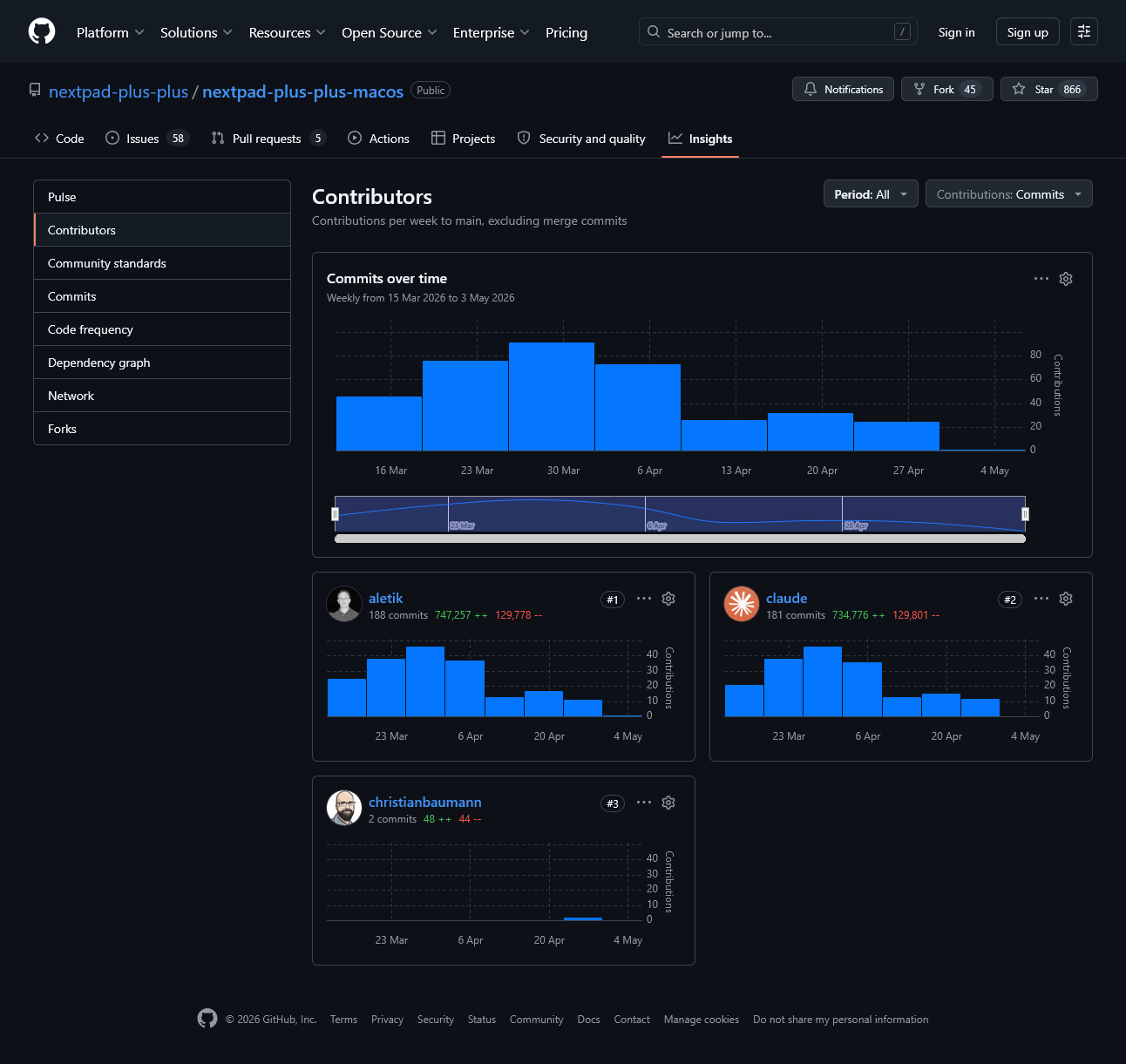
There were 191 commits in the repository at the time of writing. Let’s check out the contributors page:
@aletik: 188 commits, 747k lines added, 129k lines deleted@claude: 181 commits, 734k lines addded, 129k lines deleted@christianbaumann: 2 commits, 48 lines added, 44 lines deleted
This codebase was written almost entirely by Claude. Furthermore, it is easy to notice Claudisms when looking at commits not attributed to Claude, such as section headers made out of em-dashes in the initial commit (11k lines added). Another commit without a Claude attribution has an extremely long commit message — again, very Claude-y, very em-dash-y1.
The Claude Code attribution is the last line of the commit message. For example, here’s a random commit2:
| $ git show --stat 8e2b0749fc4354532d89572fb7b6ae7ec6bf8e41
|
| commit 8e2b0749fc4354532d89572fb7b6ae7ec6bf8e41
|
| Author: Andrey Letov <[email protected]>
|
| Date: Fri Apr 24 17:57:25 2026 -0400
|
|
|
| Bump host to 1.0.5
|
|
|
| CMakeLists.txt (BUNDLE_VERSION + SHORT_VERSION_STRING) and
|
| resources/Info.plist (CFBundleVersion + CFBundleShortVersionString)
|
| roll from 1.0.4 → 1.0.5. Local DMG built but not pushed / notarized
|
| yet — release ships in a couple of days.
|
|
|
| Headline addition since 1.0.4:
|
| - Pin / unpin toggle on popped side panels (defaults to unpinned;
|
| was forced always-on-top in v1.0.4).
|
|
|
| Co-Authored-By: Claude Opus 4.7 (1M context) <[email protected]>
|
|
|
| CMakeLists.txt | 4 ++--
|
| resources/Info.plist | 4 ++--
|
| 2 files changed, 4 insertions(+), 4 deletions(-)
|
GitHub picks up those attribution lines and shows them when viewing commits (“user and claude committed”), and includes them in the commit tally on the contributors page. But how does Git know to add this attribution? Is it some magic feature where Claude secretly writes a file for Git to pick up? Nope! Claude will include that attribution when it commits the changes. But by default, Claude will not commit anything when it finishes implementing your request. You need to explicitly ask it to commit, or include that in your instructions files (e.g., CLAUDE.md).3
If someone were to review the changes before committing, they would most likely do it in a code editor, navigating using the Git pane, so they see the commit box right in front of them, and they could just spend a minute writing a reasonable commit message. But nah, why bother with code review, let’s just vibe our way onto MacRumors.
So: if you see the Claude attribution appear in a commit, you can be sure the commit is unreviewed slop. And if virtually all commits in a project have a Claude attribution, the project is certified 100% slop. Especially since you can disable the attribution in Claude configuration, so the authors of those projects don’t care at all about hiding their code’s sloppiness.
-
LLMs learning to use em-dashes from well-typeset books has ruined good typography. I’ve been using a custom keyboard layout since 2012, with em-dashes and “smart” quotes, but I’ve significantly limited the use of those characters since they became the tell-tale signs of LLM writing. (This post is 100% human-written.)↩
-
I picked a relatively recent one, with a fairly short commit message, an Unicode arrow (→), an em-dash, and where the only change is updating the version numbers in two files. This is why we can’t have nice things (and RAM).↩
-
It should be noted that VS Code has recently introduced a feature where it will sneakily add a Copilot attribution, and they managed to make it apply it to all commits, even when AI features are disabled (why was that
allvalue even implemented?), but that feature attributes Copilot, not Claude, even if you’re using Claude models within VS Code.↩